
The Met department blamed the malfunctioning of sensors kept at the Automated Weather Station for the gaffe.
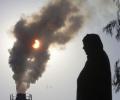
According to a study by the medical journal, the Lancet, air pollution has emerged as the deadliest form of pollution and the fourth leading risk factor for premature deaths worldwide.

Temperatures in 17 locations breached 48 degrees Celsius on Monday, with the relentless heat affecting health and livelihoods across large parts of northwestern and central India.

Temperatures remained above 45 degrees Celsius in large parts of Rajasthan, Haryana, Delhi, Chandigarh and Uttar Pradesh, affecting daily life as many chose to remain indoors in the afternoon.

Low temperature -- Delhi recorded a minimum of 13.5 degrees Celsius on Tuesday, the season's lowest so far -- allowed accumulation of pollutants, said Mahesh Palawat, vice president (meteorology and climate change), Skymet Weather.

Kharif crops were sown in only 4.15 lakh hectares against the target of 28.27 lakh hectares till July 21 or only in 14.71 per cent of the arable land.

The powerful cyclone, strongest to hit India in 20 years, made landfall at around 8 am in India's eastern state of Odisha, killing at least 12 people.

The health minister said the Centre has taken timely measures ahead of the summer season to address heatwave-related illnesses.

'Urbanisation results in heavy rainfall events.'

The El Nino impact on the Indian monsoon typically manifests by way of extended break in rainfall.

The mercury breached the 46-degree Celsius mark in several places such as Allahabad (46.8 degrees Celsius) and Jhansi (46.2 degrees Celsius) in Uttar Pradesh; Sports Complex (46.4 degrees Celsius) in Delhi; Ganganagar (46.4 degrees Celsius) in Rajasthan; Nowgong (46.2 degrees Celsius) in Madhya Pradesh; and Maharashtra's Chandrapur (46.4 degrees Celsius).

ISRO chairman S Somanath said the success gave the space agency "greater confidence," as the GSLV will be next deployed in the NISAR mission, a collaborative effort with the US' NASA.

Swarms of immature pink locusts and adult yellow locusts are currrently active. Not only are fresh locusts swarms expected to arrive in the coming weeks, but even those already present in India have mated and are breeding new offspring.

The IMD DG said there should not be an impression that climate change leads to rise in the temperature, but on the contrary, it leads to erratic weather.

A joint research programme between the Indian Institute of Tropical Meteorology (IITM) and the University of Reading, UK on `Science of Regional Climate Change, Variability and Impacts`, has been selected for a `Major Award` under the UK-India Education and Research Initiative (UKIERI).

Gore, who was US President Bill Clinton's deputy in 2000, made the 2006 Oscar-winning documentary An Inconvenient Truth, after which he was seen as a champion of environmental issues and climate change.

'It could rain about 200 mm in short span of time.'
'AI can be very useful for making analysis and especially making city-based local forecasts.'

The India Meteorological Department has issued an 'orange' alert.

Yadav's comments came amid concern expressed by some experts on the cheetah project and that some recent deaths could possibly be due to infection caused by radio collars though that is highly unusual and collars have been used in wildlife conservation in India for over two decades.

A research shows that the health of the majestic Gangotri glacier that feeds the river Ganges has been affected, as the maximum temperature in the region has shot up by 0.9 degree Celsius and snowfall reduced by 37 cm annually.


With rainfall and monsoons becoming highly unpredictable partly due to climate change and partly due to usual changes in weather patterns, it is such innovations by IMD which will help in planning better, reports Sanjeeb Mukherjee.

The southwest monsoon has started on a weak note and this has delayed the sowing of kharif crops. Though a cause for concern, the situation hasn't reached a stage where it warrants any panic response. Moreover, according to meteorologists and industry players, monsoon rains will witness a revival in the coming few weeks.

Airlines such as Vistara and SpiceJet warned their passengers on Twitter that due to the bad weather in Delhi, their flights might get affected.

Temperatures in March will be critical to determining the impact of any unusual heatwave conditions on this year's wheat crop in North India. It is that time of the year when the crop enters its vital grain-filling stage, say meteorologists and crop experts. So far, the high day temperatures in the North are not believed to have any significant impact on the final yields since the crop hasn't entered a stage where heat affects yields.
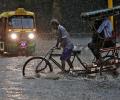
It's still early days, but the southwest monsoon has been nearly 37 per cent 'below normal' in the first seven days (June 1-7) of this month. According to the data furnished by the India Meteorological Department (IMD), between June 1 and June 7, India received 14.5 millimetres (mm) of rainfall, against a 'normal' 23.1 mm. Among places where rains have arrived, monsoon in Kerala in the first seven days has been 48 per cent 'below normal', while in Puducherry, it has been 56 per cent 'above normal'. In Tamil Nadu, rains were 21 per cent 'above normal' between June 1 and June 7.

Between June 1 and July 28, about 32 per cent of the 685 districts in the country did not receive adequate rainfall.
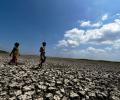
The onset of the southwest monsoon is being keenly watched this year as it may provide an early sign regarding its progress over the Indian subcontinent, particularly when El Nio is expected to rear its head during the latter half of the season.

Cyclone 'Biparjoy' has an extensive damaging potential and it is likely to impact Kutch, Devbhoomi Dwarka and Jamnagar districts of Gujarat the most, the India meteorological department said on Tuesday.

The World Meteorological Organisation assessment which was released on Monday in Marrakech, Morocco said that 2016's global temperatures are approximately 1.2 C above pre-industrial levels.

The southwest monsoon might finally start withdrawing from parts of North-West India over the next three days, signaling the end of its four-month journey over the country that started in June, the India Meteorological Department (IMD) said. However, though the retreat might begin from next week, the rains might not descend quickly, as the met department predicted fresh spells of rains in Vidarbha, Chhattisgarh and east MP on September 21-22 and over Odisha, Coastal areas north Andhra Pradesh and Gangetic West Bengal on September 19-21. "Due to anti-cyclonic flows over northwest India at lower tropospheric levels, dry weather is very likely over west Rajasthan, Punjab, Haryana, Chandigarh and Delhi during the next five days. "Hence conditions are becoming favourable for the withdrawal of Southwest Monsoon from parts of northwest India during next three days," the IMD said.

'Till such time climatic activities resume up north in the plains and the hills, Mumbai's air quality may not improve.'
Though early days, meteorologists point towards a neutral La Nina during the initial phase of the four-month monsoon season this year that starts from June. If this holds true, by the time the rains hit the mainland, it could mean there would be one less reason to worry about the prospects of the monsoon this year. Weathermen said making any accurate prediction of how El Nino will behave and what impact it can have on the progress and distribution of rains is difficult to say at this point. A clear picture will emerge around late May or early June.

The heat index in major metro cities in the country has majorly risen since 2010 compared to a decade earlier.

Santosh Patkar of Devgadh Taluka Sindhudurg district of Maharashtra is a worried man these days. Devgadh, which is known as the home to world famous Alphonso variety of mangoes, has seen an unusual drop in yields which is affecting farmers' income. Being one of the primary agricultural produce from the area, Santosh is not untouched by this somewhat rare phenomenon. He said in his own mango garden, yields have come down by a third from most trees.

At the review meeting, chaired by cabinet secretary Rajiv Gauba in New Delhi, the IMD said above normal maximum temperatures are likely over most parts of northeast, east and central India and some parts of northwest India.

The IPCC has blamed man-made emissions for warming of the globe and long term climate change. Limiting climate change, therefore, will require substantial and sustained reduction of greenhouse gas emissions. This is the message to politicians and policy makers of the world, says Dinesh C Sharma

'It is the most prone month for the development of cyclones in the pre-monsoon period.'

The southwest monsoon season concluded on Saturday with India receiving 'below-average' cumulative rainfall -- 820 mm compared to the long-period average of 868.6 mm -- in an El Nino year.
